

Last Updated: November 22, 2026
Quick Summary
Reusable retail packaging is packaging designed to be returned, cleaned, and refilled or re-wrapped for multiple use cycles instead of being discarded after a single purchase. It is the container or wrap that reaches the shopper, such as a fabric gift wrap, returnable bottle, or refillable jar, and it differs from reusable transport packaging like pallets and crates.
- Consumer return rates depend almost entirely on convenience, so build return points into existing habits.
- Grocery reuse systems work best because the checkout already serves as the return point.
- A reuse system runs on five stages: sale, return, collection, cleaning and inspection, then redistribution.
- Track return rate, rotations per package, loss rate, damage rate, and cost per use from the first cycle.
- For a 25cm item, a 55 x 55cm wrap gives enough room to tie a secure knot.
Table of Contents
- Reusable Retail Packaging Explained
- Reusable Packaging Examples in Retail and Grocery
- Reusable Packaging Materials and What They Suit
- How a Retail Reuse System Works End to End
- Reusable Packaging Benefits for Shops and Shoppers
- Reusable Packaging vs Recyclable Packaging
- How Many Times Must Packaging Be Reused to Pay Off
- Hygiene, Food Safety and the Rules That Apply
- Choosing Reusable Packaging for Gifts and Special Occasions
- Frequently Asked Questions
Reusable Retail Packaging Explained
Reusable retail packaging is packaging designed to be returned, cleaned, and refilled or re-wrapped for multiple use cycles instead of being discarded after a single purchase. A wrap that survives many gift-giving occasions can replace a stack of paper that would otherwise go straight into the bin. The concept sounds simple. The execution is where most shops get stuck.
The confusion starts with the word "packaging." It covers two very different things, and mixing them up leads to bad decisions.
Reusable retail packaging is the container or wrap that reaches the shopper: a fabric gift wrap, a returnable bottle, a refillable jar. Reusable transport packaging is what moves goods between businesses: pallets, crates, bins, intermediate bulk containers. One is a customer experience decision. The other is a logistics decision. A shop can adopt one without the other, and many do.
Below, we break down both, explain how a reuse system actually runs, and show where the environmental case holds up and where it does not.
Retail Packaging vs Transport Packaging: Two Different Jobs
Retail packaging protects and presents a product to the person buying it. Transport packaging moves that product through the supply chain without damage. A returnable plastic crate never meets the shopper; a fabric-wrapped gift box never rides a pallet.
The distinction matters because the return loop looks nothing alike. Transport packaging returns on scheduled routes between warehouses and stores, often tracked by the pallet. Consumer-facing packaging returns through a shopper's decision, which is far less predictable.
What most guides miss is that consumer return rates depend almost entirely on convenience. A return point that requires a separate trip will underperform one built into the next purchase. Design the loop around existing habits, not around ideal behaviour.
Reusable Packaging Examples in Retail and Grocery
Reusable packaging examples fall into a handful of practical formats. Here are the ones that show up most in retail and grocery:
- Returnable bottles and jars for drinks, dairy, and preserves, collected at the point of sale
- Refillable containers for dry goods, detergents, and cosmetics, filled in-store from dispensers
- Reusable produce crates and bins used at grocery counters and markets
- Fabric wraps and gift bags for presents, replacing paper and tape entirely
- Returnable totes and boxes for click-and-collect and delivery orders
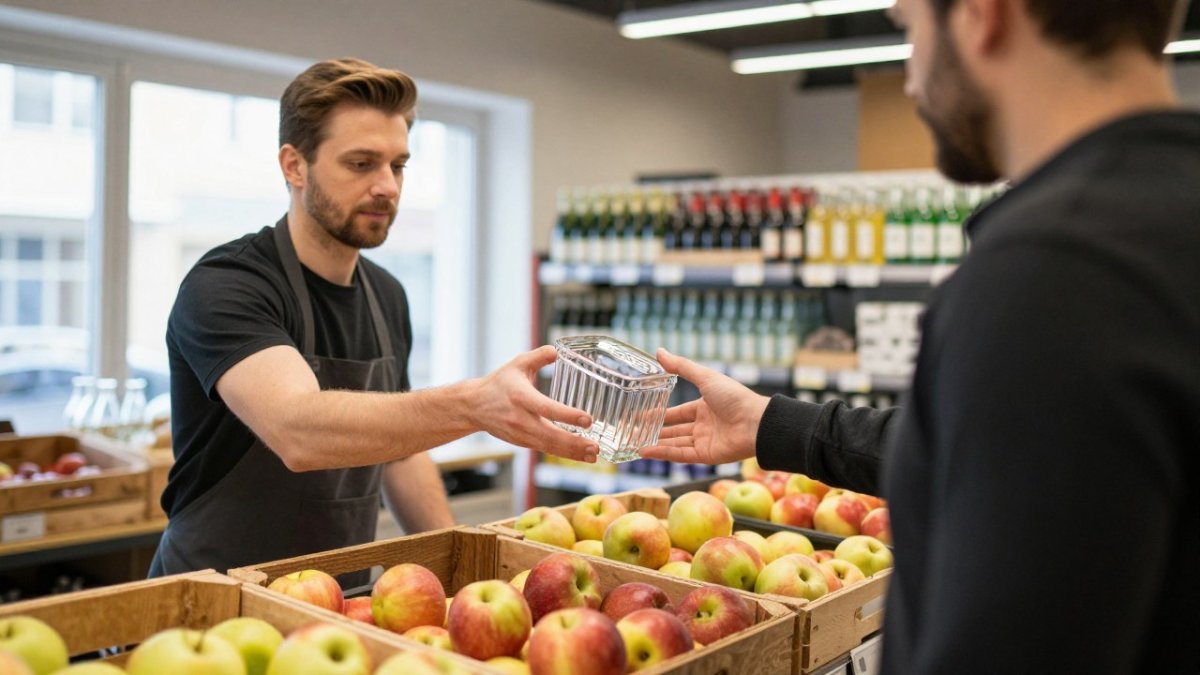
Grocery retail is where reuse systems have advanced furthest, largely because the return point already exists: the checkout. A shopper who brings a container back is standing in the shop anyway. That single fact explains why deposit schemes for bottles work and why standalone return stations often do not.
A common mistake is launching a reuse format without a collection system behind it. The packaging is the easy part. Collection is the work.
Reusable Packaging Materials and What They Suit
Material choice decides how many rotations a package survives, and that number decides whether reuse makes environmental sense at all. The review of reusable packaging sustainability in Sustainable Production and Consumption describes reusable packaging as an option proposed to reduce environmental impacts, with the caveat that the benefit depends on how the system is run.
- Textiles: cotton and silk wraps suit gifts, apparel, and anything where presentation matters. Machine washable fabric holds up across many cycles.
- Glass: heavy but inert and easy to clean, which makes it a strong fit for food and drink.
- Rigid plastics: light and durable, common in crates, bins, and containers.
- Metals: tins and drums suit bulk goods and long storage.
For fabric specifically, certification is a useful filter. GOTS-certified organic cotton and Oeko-tex mulberry silk give a buyer something to check rather than a claim to trust. Our wraps are made from GOTS-certified organic cotton and Oeko-tex mulberry silk. on why GOTS certified textiles matter for gift wrapping explains what the standard actually covers.
Each material suits a different job, and the choice decides how many rotations a package survives.
Material |
Best suited to |
Key property |
|---|---|---|
Textiles |
Gifts, apparel, presentation-led items |
Machine washable, holds up across many cycles |
Glass |
Food and drink |
Heavy but inert and easy to clean |
Rigid plastics |
Crates, bins, containers |
Light and durable |
Metals |
Bulk goods and long storage |
Tins and drums |
How a Retail Reuse System Works End to End
A retail reuse system runs on five connected stages: sale, return, collection, cleaning and inspection, then redistribution back into stock. Break any one and the loop stalls. What most guides leave out is who owns each stage and what has to be true for it to function.
1. Sale. The retailer sets the deposit or incentive and records the packaging as an asset rather than a cost. In a deposit scheme, the amount is charged at checkout and refunded on return; in a bring-your-own format, the incentive is usually a discount or a loyalty credit.
2. Return. The shopper brings the package back. Return rates depend almost entirely on convenience, so the return point should sit where the shopper already is: the checkout, the delivery driver on the next order, or a collection locker.
3. Collection. Collected items move from stores to a processing point. This is reverse logistics, and it is the least glamorous part of reuse and the part that decides whether the system works.
4. Cleaning and inspection. Each item is washed to the regime its material and use require, then inspected for damage, odour, and residue. Items that pass go back into circulation; items that fail are retired.
5. Redistribution. Clean items return to stock, either at the store that collected them or at a central point. Redistribution closes the loop and restarts the cycle.
Return Points, Reverse Logistics and the Reuse Cycle
Reverse logistics is the movement of goods backwards through the supply chain, from shopper to processor to shelf. Return points work best where shoppers already are: the checkout, the delivery driver, the collection locker. Deposit schemes add a financial nudge. Both raise participation, and participation is the metric that matters most early on.
A practical pattern is to start with one product category and one return channel, measure the return rate and rotations per package for a full cycle, then expand. Launching several formats at once makes it impossible to tell which part of the loop is failing.
Watch out: a reuse system with no clear answer for damaged or unwanted returns will accumulate unusable stock. Set the rules before launch, including what happens to an item returned damaged, an item returned after the deposit window, and an item that fails inspection. If you are planning returns for a fabric product, our return and refund policy shows how we handle it.
To assess feasibility before committing, track five numbers from the first cycle: return rate (returns per sale), rotations per package (uses before retirement), loss rate (items not returned), damage rate (items failing inspection), and cost per use (total system cost divided by total uses). Most practitioners find that return rate and rotations per package drive the economics far more than the upfront unit cost of the packaging itself.
Reusable Packaging Benefits for Shops and Shoppers
Reusable packaging benefits split cleanly between the two sides. Shops gain lower material spend per use, a differentiated unboxing experience, and a story worth telling. Shoppers gain a tangible object instead of waste, and often a better one.
The shopper side is underrated. A reusable wrap or a solid returnable container feels like part of the gift, not the wrapping. That is why we design our wraps to be kept and reused rather than torn open and thrown away.
Cost per use is the number to track. A single-use item costs the same every time. A reusable one costs more upfront and less with every rotation. The break-even point is the question worth answering before you commit.
Reusable Packaging vs Recyclable Packaging
Reusable packaging vs recyclable packaging comes down to what happens after use. Recyclable packaging is processed once and becomes raw material. Reusable packaging stays a package, again and again, until it wears out.
Recyclable is not a free pass. Recycling still consumes energy and water, and actual recycling rates vary widely by material and local collection. Reuse avoids that processing step for as long as the item stays in circulation.
The honest position: both have a role. Reuse wins where the loop is short and the item is durable. Recycling wins where return logistics would be absurd, such as a jar shipped across the country for a single refill. Choosing between them is a logistics question, not a moral one.
How Many Times Must Packaging Be Reused to Pay Off
There is no single break-even number, and any guide that gives you one is guessing. The threshold depends on the material, the weight, the transport distance, and how the item is cleaned.
What the research does support is the direction: the Food Packaging Forum's summary of consumer perspectives on reusable packaging reports that in a reusable cup trial, raw-material impacts per use declined over time as the packaging was used repeatedly. The environmental case strengthens with every rotation.
A practical way to estimate it for your own shop:
- Compare the material and production impact of one reusable item against one single-use item
- Add the impact of one wash cycle, based on your actual cleaning method
- Divide the reusable item's total impact by the number of uses you realistically expect
- If the result is lower than the single-use figure, reuse wins for your case
The Center for the Circular Economy's work on reusable packaging points to the same conclusion: durability and repeated use carry the environmental case, not the material alone.
Hygiene, Food Safety and the Rules That Apply
Hygiene requirements differ by use case, and getting them wrong is the fastest way to lose shopper trust. For food-contact reuse, the relevant framework in Germany is food-safety law. Readers should check the current requirements with the official sources and with their supplier before setting up a food-contact system.
In practice, a food-contact reuse system needs three things documented: the cleaning regime (method, temperature, detergent, contact time), the inspection criteria (what counts as a pass or fail), and the traceability record (which item was cleaned when and by whom). The cleaning regime should follow the supplier's specification for the material; a container that cannot be cleaned to that specification should not enter the loop.
For non-food reuse, such as gift wrap or apparel packaging, the requirements are lighter but not absent. A machine-washable fabric with a stated temperature is far easier to run through a hygienic cycle than a delicate one, and a stated retirement rule (for example, retire after a set number of washes or on first sign of damage) keeps the loop honest.
Watch out: reusing a container for a different product than it was designed for can create a hygiene problem the original specification never covered. Keep food and non-food loops separate, and do not move a container from a non-food use into food contact without re-assessing it against the food-contact requirements.
Consumer concerns are part of the operational picture. Our wraps are machine washable.
Choosing Reusable Packaging for Gifts and Special Occasions
For gifts, the reuse decision is simpler than for grocery, because the packaging is part of the present. A fabric wrap in a considered pattern does the job paper does, then stays in the recipient's home instead of the bin.
Size is the practical starting point. Choose a wrap with a diagonal length roughly three times the longest side of the object. For a 25cm item, a 55 x 55cm wrap gives enough room to tie a secure knot without stretching the fabric.
Our step-by-step guide to using fabric wraps for retail packaging walks through the folds, and if you want to start with a single piece, the Cherry furoshiki wrap at €11.99 is a straightforward entry point in GOTS-certified organic cotton.

For larger presents, a 75 x 75cm wrap handles laptops, shoeboxes, and oversized books, and doubles as a tote bag afterwards. That second life is the point: the wrap keeps working long after the gift is opened.
Reusable packaging only pays off when the loop actually closes, and that means choosing formats people will genuinely keep, clean, and use again. FabRap makes wraps from GOTS-certified organic cotton and Oeko-tex mulberry silk, machine washable and durable enough for repeated use, with reversible designs. Orders ship plastic-free in recycled and biodegradable materials, and our 14-day happiness guarantee lets you try a wrap with confidence. Get started with FabRap and give your gifts a wrapping that lasts for years, not minutes.
Frequently Asked Questions
What is reusable retail packaging?
Reusable retail packaging is packaging designed to be used many times rather than thrown away after one purchase. It covers consumer-facing items such as refillable bottles, fabric gift wraps and returnable containers, plus transport packaging like crates, pallets and reusable plastic containers that move goods between suppliers and shops. The defining feature is a planned reuse cycle: the packaging is collected, cleaned, inspected and put back into circulation, so its environmental value depends on how many rotations it completes.
What are common reusable packaging examples in shops?
Look for refill stations for detergents and dry goods, deposit-and-return bottle schemes, reusable produce crates, and fabric wraps used instead of paper and tape. Transport side examples include pallets, bins, tanks and intermediate bulk containers that shuttle between warehouses and stores. Reusable packaging examples also include gift bags and furoshiki cloth wraps, which shoppers keep and pass on rather than discard after a single celebration.
What is the difference between reusable and recyclable packaging?
Recyclable packaging is used once and then processed into new material, which still requires energy and collection infrastructure. Reusable packaging stays in service through multiple rotations, so its impact per use falls with every cycle. The comparison matters: a recyclable box avoids landfill only if it is actually collected and reprocessed, while a reusable crate avoids new material entirely for as long as it survives inspection and cleaning. Reusable packaging vs recyclable packaging is really a question of loops versus single passes.
How many times does packaging need to be reused to be sustainable?
There is no single universal number, because it depends on the material, weight and washing method. Research on reusable packaging notes that raw-material impacts per use decline over time as rotations accumulate, which means repeated use is what makes the environmental case work. Heavier packaging generally needs more rotations to break even than lightweight fabric or thin plastic. Ask suppliers for a life-cycle assessment or cost-per-use figure rather than accepting a reuse claim at face value.
What materials are used to make reusable packaging?
Common reusable packaging materials include durable plastics for crates and containers, wood for pallets, metal for tanks and drums, glass for bottles, and textiles such as organic cotton for wraps and bags. Material choice should match the job: crates need rigidity and stackability, food containers need easy cleaning, and gift wraps need softness and washability. Certified organic cotton, for instance, is machine washable and holds up across many uses, which suits consumer-facing reuse.
Can fabric gift wrap be considered reusable packaging?
Yes. Fabric gift wrap is consumer-facing reusable packaging: a cloth is folded around a present instead of using paper and tape, then kept and reused for future gifts. Because it is washed and reworn rather than discarded, its impact per use drops with every occasion. FabRap's furoshiki-style wraps, made from GOTS-certified organic cotton, are machine washable and designed for repeated use, so a single wrap can serve many gifts over time.
